Contents Home Performance IV Therapy: Benefits, Safety, and What to...
Read More

Reviewer | 22nd April | Read time – 11 mins
Dehydration is one of the most common and most underestimated reasons people feel unwell. Even mild dehydration — a loss of 1 to 2% of body water — impairs cognitive performance, increases perceived effort during physical activity, and slows reaction time. At 3 to 4% loss, headaches, fatigue, and significant cognitive impairment set in. The body is roughly 60% water, and maintaining that balance is not something it does passively.
The problem is that the situations where dehydration matters most are often the ones where oral rehydration is slowest or least practical. Nausea from illness or a hangover makes drinking difficult. Heat and exertion deplete fluids faster than most people can replace them. Long-haul flights are profoundly dehydrating. Fever, diarrhoea, and vomiting cause rapid fluid and electrolyte losses that water alone cannot correct. In all of these scenarios, IV hydration bypasses the gut and replaces fluid volume directly, rapidly.
This article covers what hydration IV therapy actually does and where it is most useful, how dehydration affects the body, when IV delivery is meaningfully better than drinking, who should not receive it, what a session involves, what it costs in India, and what to look for in a provider.
Hydration IV therapy is the most clinically straightforward IV protocol — the evidence for intravenous fluid replacement is not emerging, it is foundational to hospital medicine. The question for wellness contexts is more specific: when does IV delivery offer a meaningful advantage over simply drinking more?
Yes — and the advantage is most pronounced when the gut itself is the problem. Nausea, vomiting, or diarrhoea make oral rehydration slow and unreliable. IV delivery bypasses the gut entirely, restoring circulating blood volume directly. IV treatment of severe dehydration, exertional heat illness, nausea, emesis, or diarrhoea, and in those who cannot ingest oral fluids, is clinically indicated — while for milder cases, the American College of Sports Medicine confirms oral fluids and electrolytes are equally effective. [2] The practical implication: if you can drink comfortably, drink. If you cannot — or if time matters — IV is faster and more reliable.
Alcohol causes dehydration through two mechanisms: it suppresses antidiuretic hormone, increasing urine output; and it drives electrolyte loss alongside the fluid. The headache, fatigue, nausea, and cognitive fog of a hangover are partly dehydration effects and partly acetaldehyde toxicity and inflammation. Ethanol is a diuretic that inhibits ADH secretion, resulting in fluid loss that can significantly impair post-drinking recovery. [4] IV saline with electrolytes corrects the fluid and electrolyte component rapidly — typically within 30 to 45 minutes — addressing the dehydration-driven symptoms without waiting for oral rehydration to work through an irritated gut.
For high-intensity exercise in hot conditions — which describes most outdoor sport in Hyderabad for eight months of the year — fluid and electrolyte losses can exceed what is practically replaceable during activity. Replacing 150% of body weight loss over 60 minutes through IV has been tolerated without complications, and IV is clinically indicated for severe dehydration over 7% body weight loss and exertional heat illness. [2] For most athletes, oral rehydration is sufficient for recovery. For those with significant losses, nausea, or time pressure before the next training session, IV hydration compresses recovery meaningfully.
Fever, gastroenteritis, and respiratory illness all accelerate fluid loss — through sweating, vomiting, diarrhoea, and increased respiratory rate. Maintaining adequate fluid volume supports immune function, medication metabolism, and the tissue repair processes that recovery depends on. Maintaining adequate hydration status during illness is critical for organ function and recovery, with IV delivery the appropriate route when oral intake is impaired. [3] For patients who cannot keep fluids down or who are significantly depleted, IV hydration removes the limiting factor and lets recovery proceed.
Long-haul flights are significantly dehydrating — cabin air humidity runs at 10 to 20%, far below the 40 to 60% of normal environments, and passengers typically drink less than they should during travel. The cognitive fog, headaches, and fatigue of jet lag are compounded by dehydration. Even mild dehydration of 1–2% impairs cognitive function, mood, and perceived effort — effects that compound travel-related fatigue. [1] IV hydration post-flight restores circulating volume and electrolytes rapidly, addressing the physiological component of travel fatigue in a way that drinking water over several hours does not.
Reviewer | Date | Read time
Water is not just a solvent. It is the medium in which all biochemical reactions occur, the carrier of nutrients and waste products, the coolant that regulates body temperature, and the lubricant for joints and tissues. When total body water falls, every system that depends on it degrades. Even mild dehydration — 1 to 2% body weight loss — impairs cognitive performance, mood, and physical endurance, with effects on reaction time and perceived effort measurable within one hour of fluid restriction. [1]
Electrolytes are the other half of the equation. Sodium, potassium, chloride, magnesium, and calcium are not just dissolved in body fluids — they are the charged particles that make nerve signalling and muscle contraction possible. When electrolyte balance shifts, these signals become unreliable. Muscle cramps, heart rhythm irregularities, cognitive difficulty, and extreme fatigue follow. Electrolyte imbalances — particularly hyponatraemia and hypokalaemia — carry significant clinical consequences and require correction alongside fluid replacement, not just water alone. [5]
Standard IV hydration delivers isotonic saline (normal saline or lactated Ringer’s solution), which matches the osmolarity of blood and distributes efficiently into the extracellular compartment. Electrolytes — typically potassium, magnesium, and sometimes calcium — can be added based on clinical assessment. This is meaningfully different from drinking plain water, which does not restore electrolytes and can, in extreme cases, dilute them further.
For most everyday dehydration, oral rehydration — water, electrolyte drinks, oral rehydration salts — is appropriate and effective. IV hydration is not a replacement for drinking. It is a tool for the specific situations where drinking is slow, inadequate, or impractical.
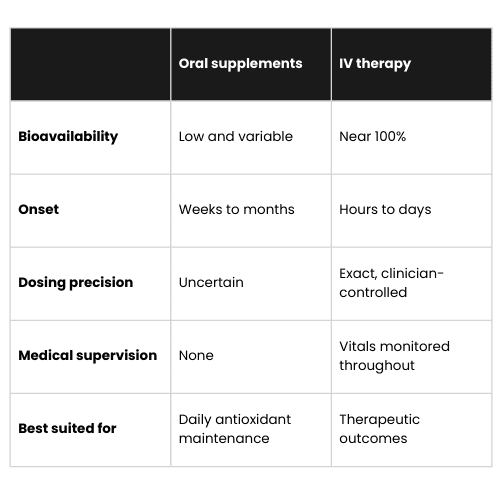
The speed advantage is real and measurable. Oral fluids take 45 to 90 minutes to meaningfully raise circulating blood volume as they are absorbed through the intestinal wall. IV fluids begin raising blood volume within minutes. IV rehydration achieves euhydration significantly faster than oral rehydration in controlled settings, making it clinically preferred when time is the limiting factor. [2] For a professional who needs to function in three hours, or an athlete with a match tomorrow, or a traveller who landed depleted and has a full day ahead — the timing difference is practically significant.
The nausea problem is the other key factor. When the gut is irritated — whether from alcohol, illness, heat exhaustion, or motion sickness — oral rehydration is not just slow, it actively fails. Attempting to drink enough while nauseous often makes the nausea worse. IV delivery removes the gut from the equation entirely.
If you want to know whether Hydration IV Therapy fits what you’re experiencing, our clinical team is happy to walk you through it

IV hydration with isotonic saline or lactated Ringer’s solution has the best-established safety profile of any IV intervention — it is the most administered IV fluid in medical practice globally. In a wellness context with appropriate screening, serious adverse events are rare.
The main risks relate to volume and electrolyte management. Over-infusion of saline can cause fluid overload — a concern primarily in patients with heart failure, severe kidney disease, or significant hyponatraemia. Patients with these conditions require clinical assessment before any IV therapy. Hyponatraemia — low sodium — can be worsened by overly aggressive rehydration with hypotonic fluids; correctly formulated isotonic saline avoids this.
Standard isotonic saline (0.9% NaCl) or lactated Ringer’s solution are safe for peripheral IV administration in healthy adults without cardiac or renal contraindications. [6] In a properly supervised wellness setting with a brief clinical screen, these risks are managed straightforwardly. The questions to ask any clinic are familiar: what preparation are you using, who is supervising, and what is the protocol if something unexpected occurs.
The clinical check is brief — heart and kidney history, current symptoms, any medications. For straightforward hangover or post-exercise hydration, this takes a few minutes. For patients with illness or more significant depletion, a slightly more thorough assessment is appropriate.
The infusion runs 20 to 45 minutes for a standard 500–1000ml volume. The experience is minimal — a cool sensation in the arm as the fluid enters, then nothing. Most patients notice a perceptible shift within the first 10 to 15 minutes: the headache begins to ease, the heaviness lifts, mental clarity returns. The full effect is typically felt within 30 to 60 minutes of the drip finishing.
There is no recovery period. Normal activities resume immediately. For hangover and illness recovery sessions, patients typically leave feeling sufficiently restored to function, rather than needing to sleep it off.
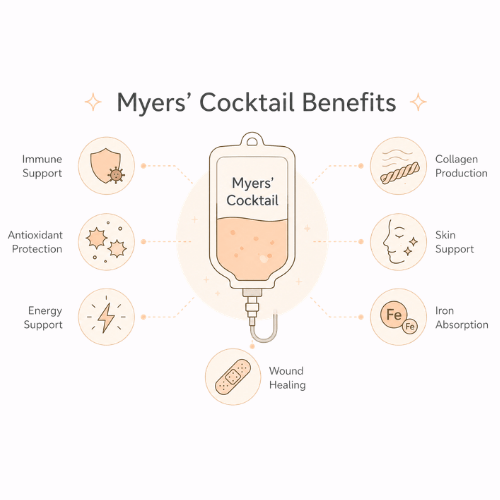
Hydration IV sessions are typically the most accessible-priced protocol in any IV menu, ranging from ₹1,500 to ₹3,500 in Indian metro cities for standard volumes with basic electrolytes. Enhanced formulations — with added magnesium, B vitamins, or vitamin C — run higher.
A fair price includes pharmaceutical-grade saline from a licensed pharmacy, a clinical consultation, trained administration, and monitoring. True Drip’s pricing is listed transparently at truedrip.in.
If you want to know whether Hydration IV Therapy fits what you’re experiencing, our clinical team is happy to walk you through it

Hyderabad’s climate makes hydration IV more clinically relevant than in most cities. Ambient temperatures above 35°C for extended periods from March through June generate sweat rates that significantly exceed typical fluid replacement — particularly for anyone exercising, working outdoors, or spending time in the heat. This is not mild dehydration territory; it is the kind of acute fluid and electrolyte depletion that compounds over days when not fully corrected.
The professional population adds the hangover and travel cohort — a city with a significant IT and corporate workforce, regular domestic and international travel, and an active social environment. Post-flight and post-event hydration sessions are consistently among the most common requests at True Drip.
Every session includes a clinical screen, pharmaceutical-grade IV preparation, and clinician-supervised delivery. For the most straightforward intervention in the IV menu, the standard is the same as everything else we do.
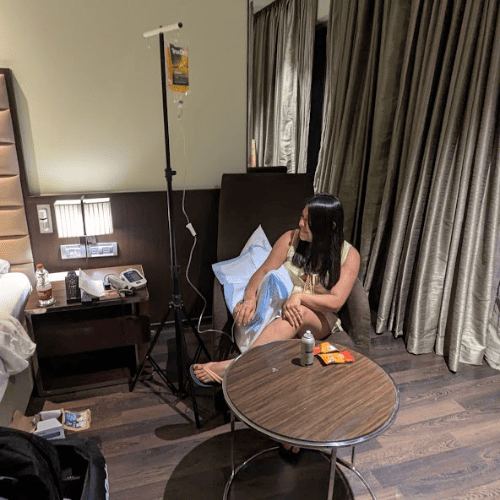
The direct intravenous delivery of isotonic saline or electrolyte solution, bypassing the digestive system and restoring circulating blood volume directly. The simplest and most clinically established IV therapy protocol.
Anyone experiencing dehydration that oral fluids are not correcting quickly enough — hangover, post-illness recovery, post-flight fatigue, heat exhaustion, or post-exercise depletion with nausea. Also used before or after significant events where optimal function matters and timing is tight.
Most patients notice improvement within 10 to 15 minutes of the drip starting, as circulating blood volume begins to restore. Full effect is typically felt 30 to 60 minutes after the session ends. The timeline is significantly faster than oral rehydration.
Standard IV hydration is isotonic saline or lactated Ringer’s solution — both match blood osmolarity and distribute efficiently into tissues. Electrolytes (potassium, magnesium) and micronutrients (B vitamins, vitamin C) are often added based on clinical assessment and the patient’s specific situation.
For healthy adults with mild to moderate dehydration, oral rehydration with electrolyte drinks is as effective as IV and is the recommended first-line approach. [2] IV offers a meaningful advantage when oral intake is impaired, when time is critical, or when electrolyte imbalances require precise correction.
Yes — it addresses the dehydration and electrolyte depletion components of hangover directly. It does not accelerate alcohol metabolism or address acetaldehyde toxicity, but for most people, the fluid and electrolyte restoration provides significant symptomatic relief within 30 to 45 minutes.
In healthy adults at standard volumes, side effects are uncommon. A cool sensation in the arm during infusion is the most typical experience. Fluid overload is the main risk in patients with cardiac or renal conditions — managed by pre-session screening.
Patients with heart failure, severe kidney disease, or significant hyponatraemia require physician assessment before IV fluid administration. Anyone with a history of fluid overload or oedema should discuss with their clinician first.
Standard wellness sessions deliver 500ml to 1000ml of isotonic saline with electrolytes over 20 to 45 minutes. Clinical decisions on volume are based on assessment of dehydration severity and the patient’s individual situation.
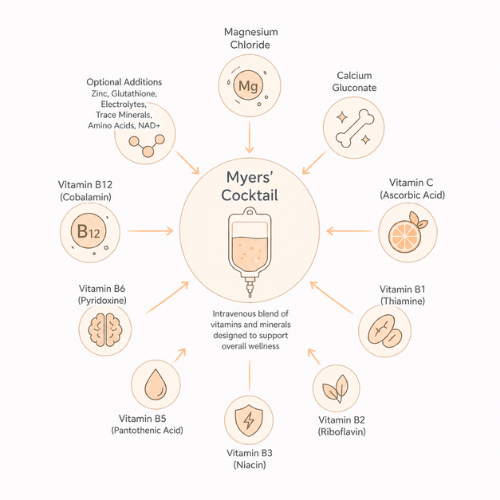
Yes — hydration is often the base of more complex formulations, with nutrients added to the saline carrier. The Myers’ Cocktail, vitamin C IV, and immunity protocols all use hydration as their foundation.
If you want to know whether Hydration IV Therapy fits what you’re experiencing, our clinical team is happy to walk you through it

Contents Home Performance IV Therapy: Benefits, Safety, and What to...
Read MoreContents Home Hydration IV Therapy: Benefits, Safety, and What to...
Read MoreContents Home Immunity IV Therapy: Benefits, Safety, and What to...
Read MoreContents Home Magnesium IV Therapy: Benefits, Safety, and What to...
Read More