Contents Home Performance IV Therapy: Benefits, Safety, and What to...
Read More

Reviewer | 22nd April | Read time – 11 mins
Dr. John Myers was a Baltimore physician who, in the 1960s, began treating patients with a simple idea: if the gut cannot reliably deliver the nutrients the body needs, bypass it. His formula — a blend of magnesium, calcium, B vitamins, and vitamin C delivered directly into the bloodstream — became one of the most widely administered IV nutrient protocols in the world. It was never patented, never proprietary. Just a formula that worked, passed from clinic to clinic across six decades.
The reason it survived is that each ingredient addresses a specific and common deficit. Magnesium is chronically low in a large proportion of the population — processed food, stress, and soil depletion have seen to that. B vitamins are consumed rapidly by energy metabolism, and oral absorption is unreliable for significant portions of people over 40. Vitamin C is depleted faster than most people replenish it. Calcium supports neuromuscular function. Together, in a single IV infusion, they reset multiple systems simultaneously rather than addressing each one separately over weeks.
This article covers what Myers’ Cocktail IV therapy does and what the evidence actually says for each component, how the formula works in the body, who it helps most, who should not receive it, what a session involves, what it costs in India, and what to look for in a provider.
The Myers’ Cocktail works because each of its components has a distinct and well-documented biological role — and because IV delivery achieves the concentrations that drive those roles effectively. Here’s what the science says about each, and how honest to be about it.
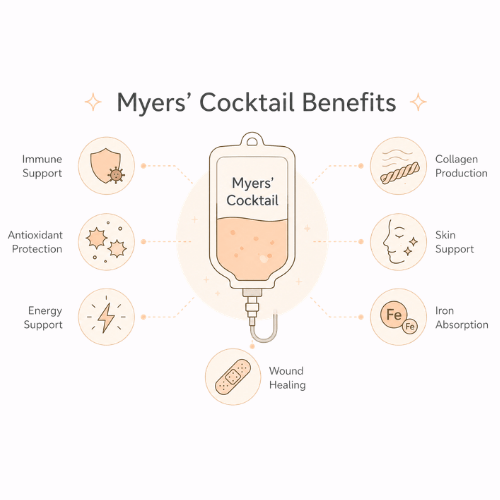
This is the most consistent clinical observation and the one with the most plausible mechanistic support. B vitamins — B1 (thiamine), B2 (riboflavin), B3 (niacin), B5 (pantothenic acid), B6 (pyridoxine), and B12 — are cofactors in the Krebs cycle and electron transport chain, the two processes your mitochondria use to convert food into ATP. Without adequate B vitamin activity, energy production slows at the cellular level regardless of how much you eat or sleep. [1]
A 2023 randomised double-blind trial in the International Journal of Medical Sciences found that B vitamin complex supplementation significantly reduced physical and mental fatigue scores and improved exercise performance in healthy adults. [2] IV delivery reaches therapeutic concentrations faster and more completely than oral supplementation, particularly for B12 in people with absorption issues. The energy mechanism is well-established; large IV-specific RCTs on fatigue in healthy adults are limited. The clinical outcome data is directionally consistent.
Magnesium is the component most directly linked to migraine, and the evidence here is among the strongest for any single ingredient in the formula. Migraine sufferers consistently show lower serum and brain magnesium levels than non-sufferers. Magnesium stabilises neuronal membranes, reduces cortical spreading depression, and modulates serotonin receptor activity — all mechanisms relevant to migraine pathophysiology. [3]
A meta-analysis published in PubMed found that intravenous magnesium reduces acute migraine attacks within 15 to 45 minutes of infusion, and oral magnesium supplementation reduces frequency and intensity over time. [4] A systematic review of randomised controlled trials concluded that high-dose magnesium provides Grade C evidence for migraine prophylaxis — modest but real. [5] For patients with frequent migraines who have suboptimal magnesium status, the Myers’ Cocktail makes particular sense. The evidence for magnesium specifically is moderate to strong.
Vitamin C is the immune-relevant component here, and its role is well-documented. Neutrophils concentrate vitamin C to levels up to 100 times higher than plasma to fuel chemotaxis, phagocytosis, and microbial killing. [6] A 2017 systematic review in Nutrients established that vitamin C supports both the innate and adaptive immune systems — including epithelial barrier function, lymphocyte proliferation, and the oxidative burst that destroys pathogens. [7] The Myers’ Cocktail delivers vitamin C at doses that meaningfully raise plasma levels. The immune support evidence is strong. Whether the combination with B vitamins and magnesium adds synergistic benefit is plausible but not directly studied.
Magnesium is the key stress-response ingredient. It acts as a natural antagonist at NMDA receptors — the same receptors that become hyperactive under chronic psychological stress — and helps regulate the HPA axis that controls cortisol production. Chronically elevated stress depletes magnesium, and magnesium depletion amplifies the stress response in a reinforcing cycle that oral supplementation alone often fails to break quickly enough. [8]
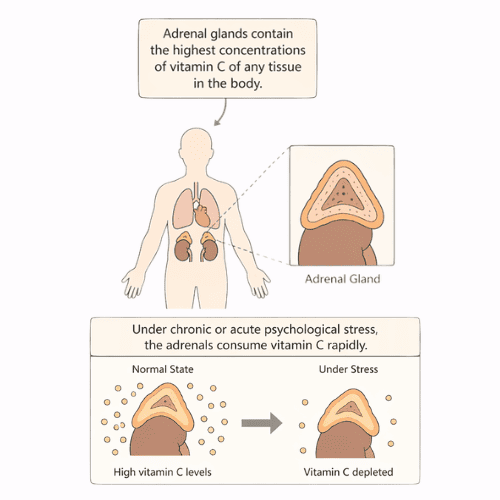
B5 (pantothenic acid) is required for adrenal cortex function and cortisol synthesis. B6 is involved in serotonin and dopamine production — the neurotransmitters most directly affected by burnout. Vitamin C, as discussed in the adrenal therapy context, is consumed rapidly by the adrenals during stress. The Myers’ Cocktail addresses all three pathways simultaneously. The mechanistic basis is sound; direct RCT evidence on burnout recovery specifically is limited.
Magnesium supports muscle contraction, oxygen delivery, and protein synthesis — all relevant to athletic performance. Vitamin C reduces exercise-induced oxidative damage and mitigates the post-exertion immune suppression window. B vitamins support the energy metabolism that exercise demands. For athletes with high training loads, frequent illness, or sluggish recovery, the combination addresses the physiological depletion pattern that follows sustained exertion. The individual ingredient evidence is moderate to strong; Myers’ Cocktail-specific sports performance RCTs are limited.
Reviewer | Date | Read time
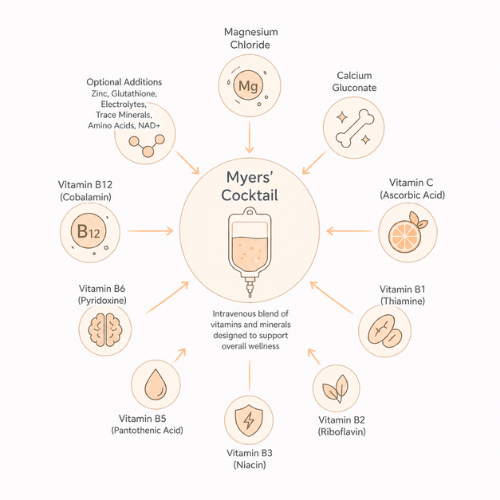
The formula Dr. Myers developed — and Alan Gaby later popularised and documented in a 2002 review — typically contains: magnesium chloride, calcium gluconate, thiamine (B1), riboflavin (B2), pyridoxine (B6), hydroxocobalamin (B12), dexpanthenol (B5), vitamin C, and sterile water. Different clinics adjust the ratios and sometimes add B-complex concentrates. The total volume is typically 100–250ml infused over 20 to 60 minutes.
Each component has a distinct job. Magnesium is the mineral most involved in enzyme function — over 300 enzymatic reactions require it, including every step of ATP synthesis and DNA replication. It is also the body’s primary natural calcium channel blocker, which explains both its muscle-relaxant effect and its relevance to vascular headaches and blood pressure. Most adults are deficient — not clinically, but functionally. Subclinical magnesium depletion doesn’t show up on standard blood panels because the body maintains serum levels by pulling from bone and intracellular stores. By the time a blood test shows low magnesium, depletion is already substantial.
The B vitamins work as a coordinated group in energy metabolism. No single B vitamin operates in isolation — they are cofactors in the same metabolic pathways and deficiency in one impairs the others’ function. Vitamin C, as covered in depth in the Vitamin C IV therapy article, is consumed faster than most people realise under stress and illness, and IV delivery reaches plasma levels the gut cannot achieve. Calcium supports neuromuscular transmission — the electrical signalling between nerve and muscle that governs everything from heart rhythm to smooth muscle tone in blood vessels.
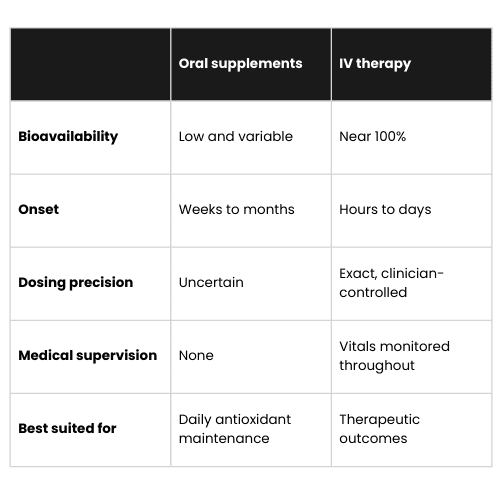
The case for the Myers’ Cocktail specifically rests on a pharmacokinetic argument: oral absorption of each component is individually limited, and those limits compound when you need all of them to work together. Magnesium at high oral doses causes diarrhoea as the gut limits absorption to protect against hypermagnesaemia — meaning therapeutic doses are simply not achievable orally without GI side effects. B12 requires intrinsic factor for absorption, which declines with age. Vitamin C saturates its gut transporter at around 500–1000mg. [9]
IV delivery bypasses all of these constraints at once. Every ingredient enters circulation at 100% bioavailability. The full therapeutic dose reaches tissues within the infusion window — not gradually over days as oral supplements are metabolised. This is particularly relevant for acute use cases: migraines in progress, severe fatigue, post-illness recovery, or pre-event athletic preparation. For these situations, speed and concentration both matter, and oral supplements simply don’t respond fast enough.
For ongoing maintenance between sessions, oral supplementation with good-quality B-complex, magnesium glycinate or citrate, and vitamin C makes sense. IV resets the baseline. Oral maintains it. The two approaches work best in combination, not in competition.
If you want to know whether Myers’ Cocktail IV Therapy fits what you’re experiencing, our clinical team is happy to walk you through it

At standard doses and infusion rates, the safety profile is good. The most common reactions — flushing, warmth, a feeling of heat or a rapid heartbeat — are caused by magnesium infused too quickly. Slow the rate, and they resolve within minutes. Magnesium delivered at the correct rate is a muscle relaxant and vasodilator; too fast, it causes the same effects transiently. This is a technique problem, not a toxicity problem, and it’s why clinical oversight during infusion matters.
Real contraindications exist and require direct screening. Severe kidney disease is the most important: magnesium and calcium are renally cleared, and impaired kidneys cannot handle therapeutic IV doses. Hyperkalaemia, severe cardiac arrhythmias, and haemochromatosis (IV vitamin C enhances iron absorption) are also contraindications. Patients on digoxin need careful calcium monitoring — the two interact. Anyone with heart failure or fluid-sensitive conditions needs physician clearance before any IV therapy.
Hypocalcaemia is a theoretical risk with magnesium-heavy formulations — the two minerals compete for cellular entry. A well-formulated Myers’ Cocktail includes calcium precisely to buffer this. Clinics substituting components without understanding the rationale introduce risks that the original formula was designed to avoid.
In India, the same question applies here as with any IV therapy: where does the preparation come from? Pharmaceutical-grade ingredients, prepared in a licensed pharmacy under sterile conditions, are non-negotiable. Improvised formulations in unmonitored spaces are a different and significantly riskier proposition. Ask directly. The answers — and any hesitation in giving them — are informative.
It starts with a clinical conversation — your health history, current medications, and what you’re hoping to address. For first-time patients, a basic screening for kidney function and any cardiac conditions is appropriate. The specific Myers’ formulation may be adjusted based on your goals: more magnesium for migraine or muscle tension, a higher B-complex ratio for energy, added vitamin C for immune support.
The infusion itself runs 20 to 45 minutes through a small cannula in the forearm vein — faster than most other IV nutrient protocols because the volume is lower. At standard rates, most patients feel a gradual warmth and a sense of relaxation as the magnesium circulates. Some notice a faint taste or smell during the infusion — the B vitamins, particularly B2, have a distinctive character that some people detect. At too-fast infusion rates, flushing or a brief hot sensation occurs — managed immediately by slowing the drip. Both resolve quickly.
Most people leave feeling noticeably calmer and clearer. The magnesium effect — reduced muscle tension, mental decompression — is often perceptible within the session. Energy improvements tend to build over 12 to 24 hours as B vitamins integrate into cellular metabolism. Immune and recovery effects follow over the subsequent days. There’s no required rest period. Normal activities resume immediately.
Sessions in Indian metro cities typically range from ₹3,000 to ₹7,000. The spread reflects pharmaceutical grade versus informally sourced ingredients, clinical infrastructure, physician involvement, and whether a proper pre-infusion consultation is included.
A fair price covers pharmaceutical-grade components from a licensed pharmacy, a clinical consultation, trained administration, monitoring during infusion, and access to a physician if something unexpected occurs. When a number looks unusually low, something in that list has been removed. True Drip’s pricing is listed transparently at truedrip.in. Most patients who come for energy or recovery goals find that a course of two to three sessions over a month produces more sustained results than a single infusion.
If you want to know whether Myers’ Cocktail IV Therapy fits what you’re experiencing, our clinical team is happy to walk you through it

The Myers’ Cocktail is the most versatile IV protocol in True Drip’s menu — and the most broadly applicable to Hyderabad’s specific population pressures. The city’s combination of high ambient temperature, which increases electrolyte and magnesium loss through sweat; high cognitive load from the tech and professional environment; disrupted sleep from demanding schedules; and limited recovery time creates exactly the depletion pattern the Myers’ Cocktail is designed to address.
Patient profiles vary significantly across the city. In Hitech City, Gachibowli, and Madhapur, the primary demand is for the energy and cognitive reset — founders, engineers, and executives who’ve been running depleted and want function restored rather than just stimulated. Jubilee Hills and Banjara Hills tend toward the wellness and recovery use case: regular maintenance, post-event recovery, and stress management for a demographic that’s already healthy and wants to stay that way. Kondapur and Secunderabad bring athletes and active patients focused on performance and post-training recovery. Across all of these, migraine patients are a consistent cohort — the magnesium component alone makes the Myers’ Cocktail the first conversation worth having for anyone managing recurrent headaches.
Every session at True Drip includes a pre-infusion consultation, pharmaceutical-grade formulation, and clinician-supervised delivery. The specific Myers’ formula can be adjusted for your presentation — that’s the point of clinical oversight rather than a fixed retail protocol.

An IV infusion of magnesium, calcium, B vitamins (B1, B2, B5, B6, B12), and vitamin C in sterile saline — delivered directly into the bloodstream to bypass gut absorption limits and achieve therapeutic nutrient concentrations rapidly. Developed by Dr. John Myers in the 1960s and refined by Dr. Alan Gaby from the 1980s onward.
People with persistent fatigue not resolved by diet and sleep, frequent migraines or tension headaches, high-stress professional or athletic lifestyles, slow recovery from illness or training, or anyone who suspects subclinical nutrient depletion across multiple systems. It’s the most broadly applicable IV protocol — suitable as an entry point for people new to IV therapy.
The relaxation and muscle-tension reduction from magnesium is often noticeable during the session itself. Energy improvements build over 12 to 24 hours. For migraines, relief is typically reported within 15 to 45 minutes of infusion when magnesium is the underlying factor. Full recovery and immune support effects develop over 2 to 4 days.
For acute use — migraine relief, post-illness recovery, pre-event preparation — a single session is appropriate. For maintenance and optimisation, most patients benefit from a monthly or bi-monthly schedule. For significant chronic depletion, a course of weekly sessions over a month is often recommended initially, then spaced out.
Myers’ Cocktail is a specific IV nutrient formulation, not a generic drip. A plain saline drip replaces fluids. The Myers’ Cocktail replaces specific micronutrients at therapeutic doses. The terms are sometimes used loosely — it’s worth asking exactly what’s in any ‘wellness drip’ you’re offered.
At standard doses and appropriate infusion rates, side effects are mild and uncommon — flushing, warmth, or a faint taste during the session. Magnesium infused too quickly causes the most common reactions, which resolve immediately when the rate is adjusted. Serious reactions are rare in clinical settings with proper screening.
People with severe kidney disease, significant cardiac arrhythmias, haemochromatosis, or hyperkalaemia. Patients on digoxin require physician review. Anyone with heart failure or fluid-sensitive conditions needs clearance before any IV therapy. Any reputable clinic screens for these before proceeding.
Most patients report noticeable improvements for 1 to 3 weeks. Energy and immune effects tend to persist longer with regular sessions. For migraine relief, effects on frequency and severity vary — some patients find monthly sessions significantly reduce their attack rate over time.
IV therapy operates under wellness and medical practice frameworks in India. The CDSCO regulates pharmaceutical standards of the individual drug substances. Preparation standards, clinical oversight, and component sourcing depend entirely on the individual provider.
Yes — glutathione, NAD+, or additional vitamin C are common additions depending on the patient’s goals. True Drip’s clinical team will recommend what combination makes sense for your specific situation. Myers’ Cocktail is also an excellent entry protocol for people new to IV therapy before progressing to more targeted treatments.
If you want to know whether Myers’ Cocktail IV Therapy fits what you’re experiencing, our clinical team is happy to walk you through it

Contents Home Performance IV Therapy: Benefits, Safety, and What to...
Read MoreContents Home Hydration IV Therapy: Benefits, Safety, and What to...
Read MoreContents Home Immunity IV Therapy: Benefits, Safety, and What to...
Read MoreContents Home Magnesium IV Therapy: Benefits, Safety, and What to...
Read More