Contents Home Performance IV Therapy: Benefits, Safety, and What to...
Read More

Reviewer | 22nd April | Read time – 11 mins
Your body cannot make vitamin C. Unlike almost every other mammal on the planet, humans lost the enzyme for synthesising ascorbic acid roughly 40 million years ago. We depend entirely on diet — and for most people living under chronic stress, eating inconsistently, or managing frequent illness, dietary intake is not keeping pace with what the body actually needs.
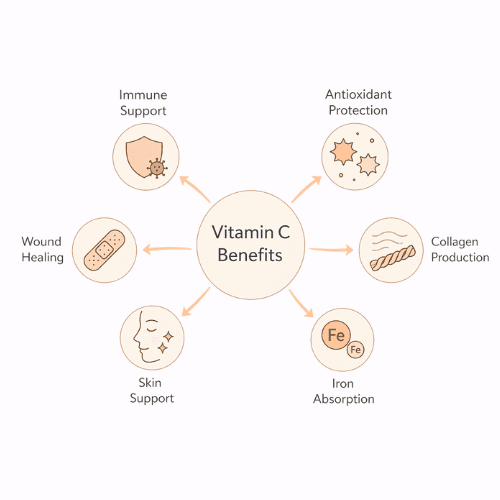
The gap matters because vitamin C is not simply an antioxidant. It sits at the centre of collagen production, immune cell function, adrenal hormone synthesis, iron absorption, and the body’s ability to neutralise the oxidative load that modern life continuously generates. When levels fall — which they do faster under stress, illness, smoking, or poor sleep — every one of those systems weakens.
This article covers what Vitamin C IV therapy does and where the evidence is strongest, how ascorbic acid works in your body, why IV delivery achieves plasma levels that no oral supplement can reach, who should not receive it, what a session involves, what it costs in India, and what to look for in a provider.
There are five clinical areas where Vitamin C IV therapy shows meaningful evidence. Some have randomised controlled trials behind them. Some rest on strong mechanistic data with human evidence still catching up. Here’s what the science actually says.
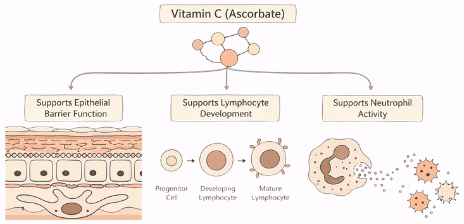
Yes! Neutrophils — your first line of immune defence — actively concentrate vitamin C to levels up to 100 times higher than plasma. [1] They use it to fuel chemotaxis, phagocytosis, and the oxidative burst that kills microbes. When vitamin C is depleted, all three processes slow.
A 2017 systematic review in Nutrients documented how vitamin C supports epithelial barrier function, lymphocyte development, and neutrophil activity — a coordinated picture of immune dependence on ascorbate. [2] A subsequent 2019 systematic review of randomised controlled trials found that IV vitamin C specifically improved neutrophil chemotaxis in hospitalised patients. [3] For frequent illness, slow recovery from infection, or high-exposure periods, the immune rationale is well-supported. The evidence here is strong.
It does, through one of the most thoroughly described mechanisms in skin biology. Vitamin C is an essential cofactor for prolyl hydroxylase and lysyl hydroxylase — the enzymes that stabilise and crosslink collagen fibres. Without adequate ascorbate, procollagen cannot mature. The result is skin that loses structure faster, heals more slowly, and responds less well to aesthetic treatments.
A 2022 review in Antioxidants (PMC9495646) confirmed that vitamin C stimulates procollagen gene expression and promotes collagen maturation at both the transcription and post-translational stages. [4] Vitamin C also suppresses tyrosinase, reducing melanin production and helping even skin tone over time. The collagen mechanism is not in question; IV-specific RCT data on aesthetics is still building. Most patients notice improved radiance within 2 to 4 weeks of a course. Structural improvements in elasticity take 6 to 8 weeks to become perceptible.
It shortens recovery — not by preventing illness outright, but by accelerating the body’s resolution of it. During infection or intense physical stress, vitamin C is consumed rapidly by the immune response. A meta-analysis by Hemilä and Chalker found therapeutic vitamin C supplementation reduced cold duration by roughly 8% in adults and 14% in children. [5]
A 2020 review in Frontiers in Immunology noted that vitamin C reduces exercise-induced cortisol and mitigates the post-exertion immune suppression window that leaves athletes vulnerable to illness. [6] The evidence is moderate and directionally consistent across populations.
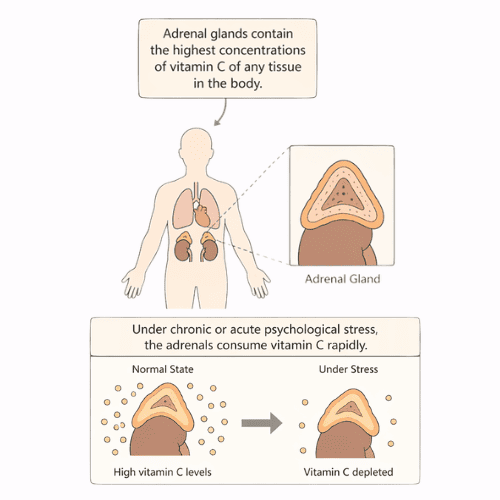
Adrenal glands contain the highest concentrations of vitamin C of any tissue in the body. They use it to synthesise noradrenaline and adrenaline — the catecholamines that drive your stress response. Under chronic or acute psychological stress, the adrenals consume vitamin C rapidly.
Replenishing it supports catecholamine synthesis efficiency and helps blunt the cortisol overshoot that prolongs recovery from high-demand periods. The mechanistic evidence is strong; human RCT data on IV delivery for adrenal support specifically is still limited.
At the pharmacological concentrations achievable only through IV delivery, vitamin C acts as a pro-oxidant in tumour microenvironments — generating hydrogen peroxide selectively in cancer cells through a mechanism related to differences in catalase activity. [7] A pharmacokinetic study in Clinical Pharmacokinetics (PMC9439974) found that IV doses up to 100g elicited no adverse effects while reaching plasma concentrations unreachable by any oral route. [8]
Phase I and II oncology trials have demonstrated safety and quality-of-life improvements alongside standard chemotherapy. These are not curative claims, and this is not a treatment to pursue outside oncology-supervised care. The mechanism is well-described; large RCT outcome data is actively being built.
Reviewer | Date | Read time
Vitamin C — ascorbic acid, or ascorbate in its ionised form — is a water-soluble molecule that acts primarily as an electron donor. This single chemical property underlies its range of biological effects: it donates electrons to neutralise free radicals, activate enzyme cofactors, and maintain the redox state that keeps cellular machinery running correctly.
In the gut, vitamin C is transported across the intestinal wall by sodium-dependent vitamin C transporters (SVCT1 and SVCT2). These transporters saturate at oral doses around 500–1000mg — which is why very high oral doses don’t proportionally raise plasma levels. The system is simply full. [9] Intravenous delivery bypasses this bottleneck entirely, allowing plasma concentrations that no oral dose can achieve.
Once in circulation, vitamin C is taken up preferentially by metabolically active or stressed tissues. Adrenals, white blood cells, and skin fibroblasts concentrate it far above plasma levels. It recycles other antioxidants — vitamin E and glutathione — restoring them to active forms after they donate electrons. It is consumed continuously: by collagen enzyme reactions, by the immune response, and by neutralising oxidative stress from environmental exposures.
The case for oral vitamin C is real. At 200–500mg daily, it maintains adequate plasma levels for someone in good health with low oxidative load. For long-term baseline support, high-quality oral supplements are appropriate and well-tolerated. [10]
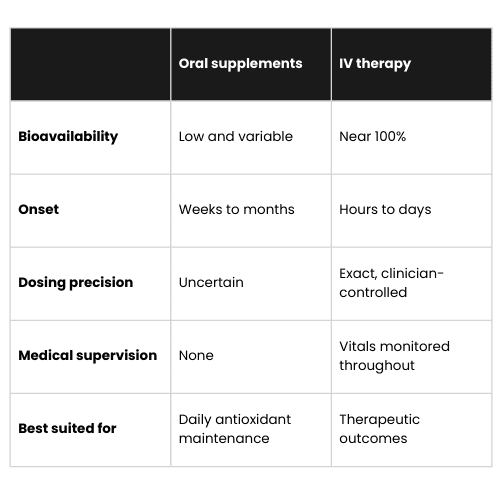
The limitation is pharmacokinetic, not philosophical. At 1.25g oral, mean peak plasma concentration is roughly 135 µmol/L. At the same dose IV, it reaches 885 µmol/L — over six times higher. At 50g IV, modelled peak plasma concentrations reach approximately 13,400 µmol/L: a level that triggers different biological mechanisms entirely and is physically unreachable through any oral route. A 2022 pharmacokinetic study confirmed IV doses up to 100g achieved complete renal clearance within 24 hours and produced no adverse physiological changes.
This is not a difference of degree — it is a difference in what the molecule can do. Collagen stimulation, immune saturation of white blood cells, and the pro-oxidant anti-tumour effects documented in oncology research all require concentrations the gut wall cannot deliver. IV is not a more expensive capsule. It is a different intervention. Liposomal oral vitamin C narrows the gap somewhat — for maintenance between sessions, it’s worth considering. It doesn’t replicate IV concentrations, but it extends the benefit window.
If you want to know whether Vitamin-C IV therapy fits what you’re experiencing, our clinical team is happy to walk you through it

Yes, at standard wellness doses with clinical oversight. The most common reactions — a cooling sensation in the arm, a faint metallic taste, or brief light-headedness — are infusion-rate effects, not toxicity signals. They resolve immediately when the drip slows. At doses of 7.5g to 25g, the safety profile is excellent and well-documented.
The most critical contraindication is glucose-6-phosphate dehydrogenase (G6PD) deficiency — a genetic condition affecting red blood cell metabolism that is more prevalent in South Asian and African populations than European ones. High-dose IV vitamin C in a G6PD-deficient patient can trigger acute haemolytic anaemia. Screening for G6PD status before high-dose sessions is not optional — it should be standard practice at any serious clinic.
Other contraindications include a history of calcium oxalate kidney stones (vitamin C generates oxalate as a metabolic byproduct), active kidney disease, haemochromatosis (iron overload — vitamin C enhances iron absorption), and pregnancy at therapeutic doses. Patients on warfarin should get physician review. Any reputable clinic screens for these before proceeding.
In India, the risk is less about the molecule and more about the setting. Pharmaceutical-grade ascorbic acid from a licensed pharmacy is a different product from informally compounded alternatives. Ask your clinic: where does your vitamin C come from? Who manages a reaction if one occurs? The answers tell you everything.
It starts with a conversation. Your clinician reviews your health history, current medications, and the specific goals driving the appointment. For first-time patients, a brief G6PD status check and kidney function review is appropriate — most reputable clinics include this as standard.
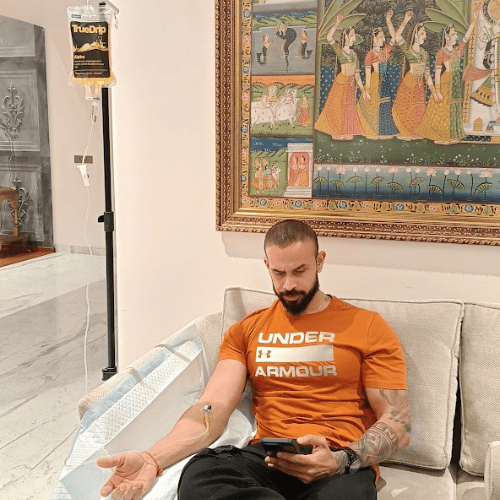
A small IV cannula goes into the forearm — a brief, sharp moment, then nothing. The ascorbic acid solution runs over 45 to 90 minutes for standard wellness doses, longer for high-dose protocols. The infusion is slow by design: too-fast administration is the main cause of mild reactions, and a calibrated drip rate prevents almost all of them.
Most patients feel very little during the session. Some notice a slight cooling in the arm or a faint smell at the back of the throat. At higher doses, very occasionally, a brief warmth or mild nausea occurs — managed immediately by slowing the rate. Some people sleep. Others work or decompress. There’s no recovery period and no activity restriction. Immune and energy improvements become perceptible in the 12 to 48 hours post-session as vitamin C distributes through tissues.
Then a small IV line is placed — identical to a blood draw — and the glutathione drips in over 30 to 60 minutes. Dosing typically ranges from 600 mg to 2,400 mg depending on your weight and objectives. Most people read, work on their phone, or just sit quietly. There’s nothing dramatic about the experience. It’s a calm half-hour in a comfortable chair.
Afterwards, you leave. No downtime. Some people notice sharper focus or a lift in energy within hours. Others don’t feel anything different until a few sessions in. Both responses are normal and expected.
Sessions in Indian metro cities range from ₹2,500 to ₹8,000 for standard wellness doses (7.5g–25g). High-dose protocols (50g and above) run higher — ₹8,000 to ₹15,000 — reflecting both the volume of pharmaceutical-grade ascorbate used and the extended clinical time required.
A fair price covers: pharmaceutical-grade ascorbic acid from a licensed pharmacy, a clinical consultation, G6PD screening for first-time patients, trained administration, monitoring during infusion, and a physician reachable if something unexpected occurs. When a number looks unusually low, one of those things has been removed. True Drip’s pricing is listed transparently at truedrip.in
If you want to know whether Vitamin-C IV therapy fits what you’re experiencing, our clinical team is happy to walk you through it

Hyderabad’s climate and urban environment create a specific case for vitamin C IV therapy worth understanding. High ambient temperatures and UV exposure accelerate ascorbate depletion — skin generates a significant antioxidant load just handling daily sun. Add the city’s air quality, which ranks among the more polluted of Indian metros, and the oxidative burden on vitamin C reserves increases further. For many residents, dietary intake is simply not keeping pace with what the environment demands.
True Drip sees distinct profiles across the city. Jubilee Hills and Banjara Hills skew toward skin — collagen stimulation, brightening, and post-procedure support. Patients here often come before or after aesthetic treatments, using IV vitamin C to prime collagen remodelling or accelerate recovery. Hitech City, Gachibowli, and Madhapur bring founders, engineers, and executives managing high oxidative load from stress and performance demands. Kondapur draws a fitness-oriented crowd. Secunderabad patients more often seek illness recovery support and general immune resilience.
Every session at True Drip includes pharmaceutical-grade ascorbic acid, G6PD screening for new patients, clinician-supervised infusion, and continuous monitoring. That’s not a premium option — it’s the baseline.
The demand here reflects a specific kind of patient: informed, time-constrained, and skeptical of anything that doesn’t have science behind it. That’s exactly the audience this treatment is designed for.
True Drip serves patients across Jubilee Hills and Banjara Hills, where the focus tends toward skin brightening and anti-ageing. In Hitech City, Gachibowli, and Madhapur, we see more interest in recovery, energy, and cognitive performance — professionals looking to function at a higher level. Kondapur draws a younger, fitness-oriented demographic interested in biohacking and performance optimisation.
Every session at True Drip includes a clinical consultation, pharmaceutical-grade formulation, and continuous medical supervision. That’s not a premium tier. It’s the only way we operate.
A clinical treatment that delivers pharmaceutical-grade ascorbic acid directly into the bloodstream through an IV drip, bypassing gut absorption and reaching plasma concentrations no oral supplement can match.
People recovering from illness or surgery, those with persistent fatigue and high oxidative stress, anyone seeking collagen and skin support, and people with elevated immune demand — frequent travel, high-intensity training, or high-stress professional environments. Also used as integrative support in oncology under physician supervision.
Immune and energy effects are typically perceptible within 12 to 48 hours of the first session. Skin improvements — brightness and texture — begin within 2 to 4 weeks of a course. Collagen structural changes take 6 to 8 weeks of consistent treatment to become perceptible.
Yes. Vitamin C is the common name for L-ascorbic acid, or ascorbate in its ionised form. These terms are used interchangeably in clinical and supplement contexts.
Because the gut wall physically limits absorption. At 1.25g oral, peak plasma concentration is roughly 135 µmol/L. At the same dose IV, it reaches 885 µmol/L — over six times higher. The gut transporter saturates; IV delivery bypasses it entirely. They serve different purposes.
At standard wellness doses with appropriate infusion rates, side effects are uncommon and mild — cooling in the arm, faint taste, or brief light-headedness. The G6PD contraindication and kidney stone history require screening before high-dose sessions. In a proper clinical setting, serious reactions are rare.
People with G6PD deficiency (screening is essential), active kidney disease, a history of calcium oxalate kidney stones, haemochromatosis, or pregnancy at therapeutic doses. Patients on warfarin should discuss with their physician before proceeding.
Immune and energy effects from a single session last approximately 1 to 2 weeks. Skin and collagen benefits build progressively over a course of sessions. Periodic maintenance — every 4 to 6 weeks — is the typical long-term approach.
IV therapy operates under wellness and medical practice frameworks in India. The CDSCO regulates the pharmaceutical standard of ascorbic acid as a drug substance. Clinical protocols, G6PD screening, and safety standards depend on the individual provider — ask your clinic explicitly.
Yes. It is commonly paired with glutathione (for antioxidant synergy and skin brightening), B-vitamins (for energy), or given as part of a Myers’ Cocktail. Your clinician will recommend what combination makes sense for your specific goals.
If you want to know whether Vitamin-C IV therapy fits what you’re experiencing, our clinical team is happy to walk you through it

Contents Home Performance IV Therapy: Benefits, Safety, and What to...
Read MoreContents Home Hydration IV Therapy: Benefits, Safety, and What to...
Read MoreContents Home Immunity IV Therapy: Benefits, Safety, and What to...
Read MoreContents Home Magnesium IV Therapy: Benefits, Safety, and What to...
Read More