Contents Home Performance IV Therapy: Benefits, Safety, and What to...
Read More

Reviewer | 5th March, 2026 | Read time 11 mins
NAD+ is a coenzyme your body makes and uses continuously. It sits inside every cell and powers energy production. Without it, your mitochondria cannot convert food into ATP — the fuel your body runs on. By age 40, most people have roughly half the NAD+ they had at 25.
The drop matters because NAD+ doesn’t just run energy. It fuels the enzymes that repair DNA, regulate inflammation, and control your body’s internal clock. As levels fall, these systems slow down. The result is a familiar cluster — flatter energy, slower recovery, slightly reduced mental sharpness — that’s easy to blame on age rather than on a specific biochemical change.
This article covers what NAD+ IV therapy does, how the molecule works, where the evidence is strong and where it’s still building, who should not get this treatment, what a session involves, what it costs, and what to look for in a provider.
There are five clinical areas where NAD+ IV therapy shows meaningful evidence. Some have randomised controlled trials behind them. Some rest on strong mechanistic data with human evidence still catching up. Here’s what the science actually says.
Yes. Your cells produce ATP through a process called oxidative phosphorylation. NAD+ carries electrons through the chain that powers this process. When NAD+ is depleted, the chain runs less efficiently. You make less ATP from the same food. The fatigue that results doesn’t fix with sleep — because the problem is energy production, not rest.
A 2018 study in Nature Communications found NAD+ precursor supplementation raised cellular NAD+ in healthy middle-aged adults over 12 weeks. [5] IV delivery gets there faster and at higher concentrations. Most people with genuine depletion notice a difference within 24 to 72 hours of a session. The mechanistic evidence is strong; IV-specific RCT data on fatigue is still growing.
It does. Neurons are the most energy-hungry cells in the body. They depend on NAD+ for ATP, mitochondrial function, and the DNA repair enzymes that handle constant neuronal activity. When NAD+ falls, neuronal energy drops and protective repair slows. [6]
A 2022 phase I trial in Cell Metabolism found NAD+ precursor supplementation improved brain metabolism in Parkinson’s patients — supporting the idea that NAD+ availability matters for neuronal energy efficiency broadly. [7] Slower processing, reduced word recall, ideas connecting less fluidly — these are consistent with depleted NAD+. The evidence is moderate and directionally consistent.
This is where the most direct clinical data exists. A 2022 pilot study of 50 patients found significant reductions in cravings, anxiety, and sleep disturbance after IV NAD+ treatment for substance use disorder. [9] The mechanism is NAD+’s role in dopamine regulation and reducing the cellular stress that drives withdrawal. The evidence here is moderate to strong.
NAD+ regulates circadian rhythms through SIRT1, the sirtuin that helps set your internal clock. Low NAD+ weakens this signal. Deep sleep deteriorates. Poor sleep then impairs the overnight recycling that replenishes NAD+ — a reinforcing cycle. [4] For frequent travellers, shift workers, or anyone with chronic sleep debt, restoring NAD+ is part of the fix. The mechanistic evidence is strong; direct IV sleep trial data is limited.
The mechanism is solid. Sirtuins — enzymes that regulate inflammation, gene expression, and cellular stress — require NAD+ as fuel. They are central to how fast cells age. NAD+ activates them; depletion silences them. [3]
Whether IV supplementation produces measurable longevity outcomes in humans hasn’t been answered by clinical trials yet. The mechanism is well-established. The long-term human outcome data is still being built.
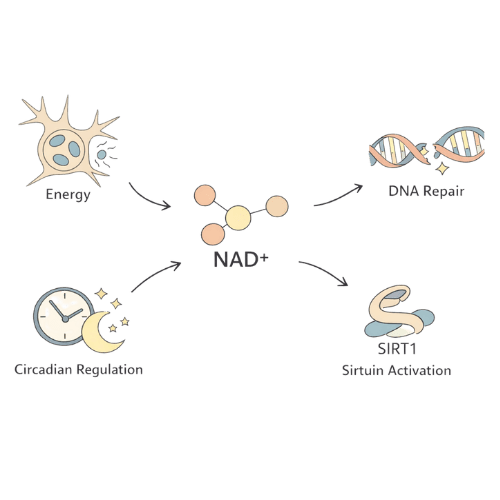
NAD+ (nicotinamide adenine dinucleotide) is a coenzyme — it makes enzymes work. It exists in two states: NAD+ (oxidised) and NADH (reduced). Shuttling between these states is how your mitochondria convert food into ATP. Without NAD+, that conversion stops.
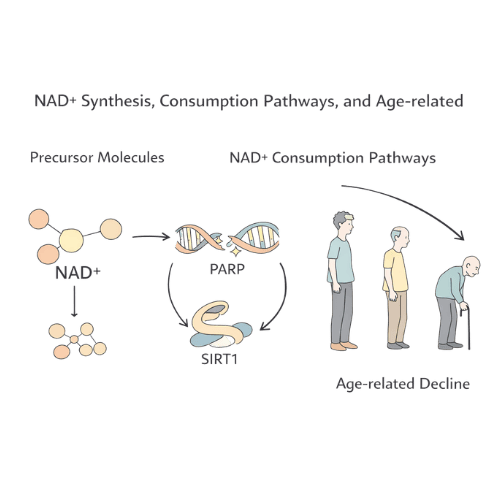
Three enzyme families compete for the same NAD+ pool. Sirtuins use it to regulate inflammation and gene expression. PARPs consume it to repair DNA damage — tens of thousands of repairs per cell per day. CD38 breaks it down during immune signalling. All three pull from the same shrinking supply. [2]
The decline accelerates with age because production slows while consumption rises. NAMPT — the enzyme that drives NAD+ recycling — slows down. CD38 activity increases as inflammatory load builds. Diet and exercise help at the margins. Neither closes the gap at the enzyme level. [3]
Oral NAD+ precursors — NMN and NR — are legitimate. They raise NAD+ over time and are well tolerated. For someone without acute symptoms who wants steady optimisation, they’re a sensible first step.
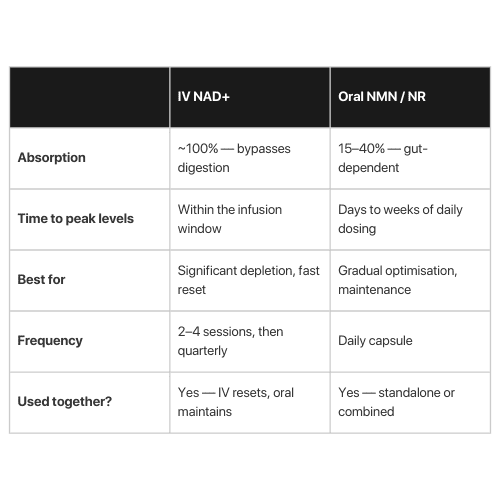
The difference is speed and concentration. Oral precursors pass through the gut and liver before reaching circulation. Absorption rates run 15–40% depending on formulation. A 2024 randomised pilot study found IV NAD+ raised whole blood NAD+ substantially faster and higher than oral supplementation at the same dose. [8] IV bypasses digestion entirely — 100% enters the bloodstream directly, and peak levels arrive within the infusion window.
For significant depletion, that speed matters. IV resets the baseline. Oral supplements maintain it. They work together, not against each other.

If you want to know whether NAD+ IV therapy fits what you’re experiencing, our clinical team is happy to walk you through it
Yes, with clinical oversight. The most common side effects — nausea, chest tightness, flushing, headache — are caused by infusion rate, not the molecule. Delivered too fast, NAD+ overwhelms the body’s metabolic processing. Delivered slowly over 2 to 4 hours, reactions are uncommon and mild. A pharmacokinetic study found no adverse events at 750mg over 6 hours, and several liver markers improved post-infusion. [10]
Real contraindications exist. Active cancer patients should get oncologist clearance — sirtuins have complex roles in tumour biology. Severe kidney disease, haemophilia, pregnancy, and certain rare metabolic disorders also rule it out. Any serious clinic screens for these before proceeding.
In India, the risk is less about the molecule and more about the setting. Pharmaceutical-grade NAD+ from a licensed pharmacy, given by a trained clinician, is a different thing from an informally prepared infusion in an unmonitored space. Ask your clinic: where does your NAD+ come from? Who handles a reaction if one occurs? The answers tell you everything.
It starts with a conversation. Your clinician reviews your health history, medications, and the specific concern driving the appointment. Dose and infusion rate are calibrated to you — not a fixed protocol.
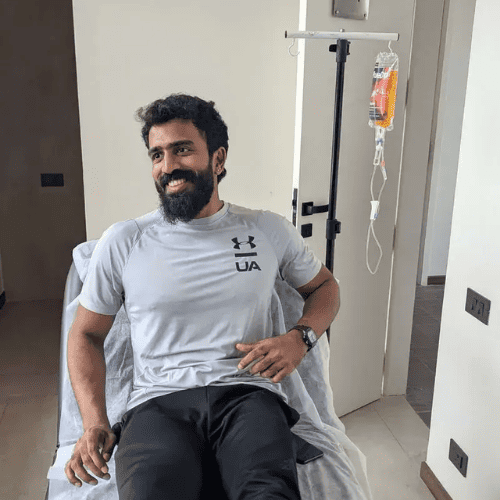
A small IV cannula goes into the forearm — a brief pinch. The NAD+ solution runs over 2 to 4 hours through a controlled pump. Most patients notice nothing in the first 30 minutes. At higher doses, mild warmth or a faint pressure in the chest can occur. These are normal metabolic responses and resolve when the rate is adjusted. Some patients sleep. Others decompress.
There’s no recovery period. Most leave feeling clear-headed and lighter. The sharpest improvements in energy and cognition tend to peak at 24 to 72 hours, as NAD+ distributes through tissues.
If you want to know whether NAD+ IV therapy fits what you’re experiencing, our clinical team is happy to walk you through it

Sessions in Indian metro cities range from ₹6,000 to ₹18,000. The spread reflects dose, pharmaceutical grade versus informally compounded NAD+, clinical infrastructure, and physician involvement.
A fair price covers: pharmaceutical-grade NAD+ from a licensed pharmacy, clinical screening, trained administration, monitoring during infusion, and a physician reachable if something goes wrong. When a number looks unusually low, one of those things has been removed. True Drip’s pricing is listed transparently at truedrip.in
The people who seek NAD+ therapy in Hyderabad are typically professionals in their late 30s to mid-50s — already doing the basics well, and noticing the results don’t match the input. That gap is often NAD+ depletion. The city’s combination of high cognitive load, disrupted sleep, pollution-driven oxidative stress, and a pace that doesn’t build in recovery time creates exactly the conditions that accelerate it.
True Drip sees distinct patient profiles across the city. Jubilee Hills and Banjara Hills tend toward longevity and anti-ageing — patients who have read the science and want to get ahead of biological decline. Hitech City, Gachibowli, and Madhapur bring founders, engineers, and executives focused on cognitive performance and sustained energy. Kondapur draws a fitness-oriented crowd interested in recovery and biohacking. Secunderabad patients more often come for burnout recovery and sleep support.
Every session at True Drip includes a clinical consultation, pharmaceutical-grade NAD+, and continuous medical supervision. That’s not a premium option — it’s the baseline.
A medical treatment that delivers NAD+ directly into the bloodstream through an IV drip, achieving near-complete absorption and raising NAD+ levels faster than any oral supplement.
People over 35 with persistent fatigue, reduced cognitive sharpness, or slow recovery that doesn’t resolve with lifestyle changes. Also used in addiction recovery and performance optimisation.
Most patients notice improved energy and clarity within 24 to 72 hours of the first session. A course of 2 to 4 sessions over a month produces sustained improvement.
Related but not the same. Niacin (B3) is a NAD+ precursor — the body converts it through several steps. IV NAD+ skips those steps and raises levels directly.
Oral precursors absorb at 15–40% and work gradually. IV achieves near-100% bioavailability within the infusion window. IV resets the baseline; oral supplements maintain it.
At an appropriate infusion rate, side effects are mild and uncommon — nausea or flushing at higher doses, managed by slowing the drip. No serious adverse events in controlled clinical settings.
People with active cancer (without oncologist approval), severe kidney disease, haemophilia, or pregnancy. Complex medication regimens should be reviewed by a physician first.
Most patients report noticeable effects for 2 to 4 weeks. Periodic sessions or oral supplementation is the standard long-term approach.
IV therapy operates under wellness frameworks in India. The CDSCO regulates the pharmaceutical standard of the compound itself. Clinical standards depend on the individual provider.
Yes. It’s commonly paired with Vitamin C, glutathione, or B-vitamins depending on patient goals. Your clinician will recommend what makes sense for you.
If you want to know whether NAD+ IV therapy fits what you’re experiencing, our clinical team is happy to walk you through it

Contents Home Performance IV Therapy: Benefits, Safety, and What to...
Read MoreContents Home Hydration IV Therapy: Benefits, Safety, and What to...
Read MoreContents Home Immunity IV Therapy: Benefits, Safety, and What to...
Read MoreContents Home Magnesium IV Therapy: Benefits, Safety, and What to...
Read More